

A Sundance Film Festival Review
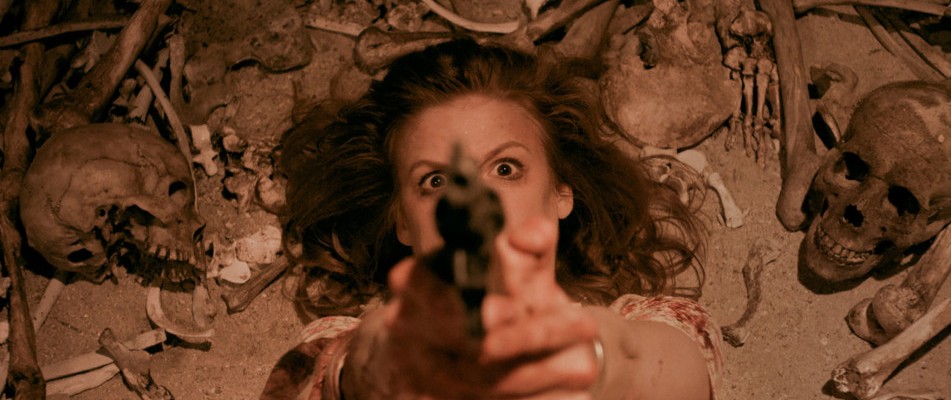
“Carnage Park” tells the tale of a woman, Vivian, taken hostage in a bank robbery that goes awry. Once out of town, the lead robber, Scorpion Joe, does his best to work his charm on his lovely hostage while attempting to form a plan that prevents him from ending up in jail. What he does not realize is that he has stumbled right into the twisted world of a crazed Vietnam veteran, a highly skilled sniper named Wyatt Moss, who does not take kindly to trespassers. The “Park” of the title is a chunk of desert where Wyatt feels free to hunt and kill anything that wanders his way – human or otherwise. This leads to a few truly disturbing scenes where Vivian encounters dead or dying survivors from Wyatt’s previous adventures. As a sniper, he has the skill to take out anyone at anytime. Watching Vivian realize the hopelessness of her predicament is a tribute to how effective actress Ashley Bell is in this role. The mood darkens heavily even though the majority of the film is played out in broad daylight. As Vivian realizes just how screwed she might be, the film manages to nicely play on her panic and attempts to find help.
Director Mickey Keating (Darling, POD) manages to stylize the movie with intense riffs on horror and political thrillers of the past. The energy created by his directorial choices is undeniable. The true strengths of the film come from strong performances and effective “stalk and chase” sequences mixed in with some seriously creepy building tension. The weakness of the film is that these elements lead toward a meandering climax in a darkened mine tunnel that, somehow, manages to deflate the tension that should be escalating to a horrifying conclusion.

Do not blame the cast. “Scorpion Joe,” played by James Landry Hébert, is a dynamic presence that quickly shows a ruthless side. By the end of act one, he provides a couple of true horror movie moments that are gems. Ashley Bell has truly vibrant passages throughout the film as the innocent gal having a really, really bad day of errand running that starts at a bank and ends with her fighting for her life in a madman’s underground lair. The villain Wyatt Moss, played with incredible intensity by Pat Healy, clearly has a sociopolitical ax to grind. His performance is so strong you actually yearn for him to get more screen time than the story allows. (If you have not seen Healy’s performance in 2013’s “Cheap Thrills,” you are missing out on something truly astounding.)
Indeed, perhaps the biggest disappointment in the film is that the effective cat and mouse antics never lead to a final cathartic showdown between Vivian and Wyatt. The characters are so well-drawn that the audience yearns for such a showdown. By the end, Ashley Bell’s heroine is such a mix of terror and desperation who, somehow, still manages to push forward through a series of horror film scenarios, we want her to get the chance at ending her nightmare in a more personal way than is ever afforded. In an effort to not get to spoilery, I am just going to leave it at that.
Another performance that should be noted is that of the local sheriff portrayed by Alan Ruck. His dilemma of being a little too closely involved with all the shenanigans going on out in them there hills adds an element to the story that helps you buy into this scenario and help make it seem all this could be more believable than it originally sounds. Ruck is, of course, a familiar face but is definitely cast in a new light here and he shines.
Indeed, there is a great deal to like while visiting “Carnage Park.” But, it is those parts you may walk away admiring more than the overall movie.
The thriller/horror film is not afraid to point obviously to the source inspirations. The overall look and feel owes much to Sam Peckinpah, but there is so much more. Director Keating claims the title itself refers to the early ‘70s thriller “Punishment Park,” which also explains some of the specific references to the Vietnam war and protests over that confllict. (The sound design of the film, certainly a plus in the overall effect the movie has on the audience, reflects this by using the sounds of both war and protest.)
It all begins with robbery gone wrong that leads to a hostage situation gone wrong. Along the way, “Reservoir Dogs” becomes an immediate and heavily influential set up for the mayhem to come, then gets another nod later with a certain body part being removed from someone. The desert landscape recalls the danger-lurking-nearby vibe of “The Hills Have Eyes.” The final underground sequence and the costuming of Wyatt is an obvious nod to “My Bloody Valentine.” Even the fact that the villain is a sniper echoes numerous 1970s paranoid political thrillers ranging from “The Parallax View” to “Black Sunday.” In some weird fashion, this mash-up of images and influences ends up making “Carnage ParK‘ more fun overall rather than derailing it. As a viewer, I found that when Keating and his team fire on all cylinders, the movie becomes hugely entertaining. Credit must be given to production designer Angel Herrera, director of photography Mac Fisken, editor Valerie Krulfeifer and composer Giona Ostinelli. This movie works because of the unity of their visions.
All of these elements are effective and play out with such energy, you enjoy the ride, even as you get an overwhelming sense of it all being vaguely familiar. However, it becomes clear early on that these elements are not going to ever meld into a finely polished whole that justifies all the borrowing from other sources.
Enjoy the ride, but don’t expect to cherish the memories of visiting “Carnage Park.” Those good memories come from other sources.
Prior to the Sundance Film Festival where “Carnage Park” premiered as part of the Midnight series, Entertainment Weekly was able to post a clip that gives a taste of the increasing suspense from early in the film.