
A review of the documentary film “The Nightmare”
(2015)
Directed by Rodney Ascher

How you interpret a film is a direct result of who you are at the moment you watch it. This is why the comedy you loved so much at the age of 15 doesn’t seem as funny, perhaps, at the age of 45. So, it was with great anticipation that I went into a viewing of “The Nightmare,” an audience favorite from the 2015 Sundance Film Festival. “The Nightmare” is a documentary including interviews and reenactments from the stories of eight people who have suffered from a condition know as “sleep paralysis.” This condition is marked by physical paralysis, even though the mind is aware and experiencing the world around you as reality, even though it may be a dream or nightmare.
There is plenty of information out there available that offers theories about the condition and possible causes. It is an occurrence that crosses many cultures, and part of this film’s appeal is the ability to point out similarities that exist between the eight people who are interviewed and common themes that run through their shared condition.
Near the end, the movie actually achieves a level of philosophical discussion about common experiences that cross multiple cultures and tie us, as human beings, to one another on multiple levels.
Why does this movie interest me right now? Three months ago, I experienced sleep paralysis for the first time.
The film is directed by Rodney Ascher, the director of the acclaimed “Room 237,” which examines theories of hidden messages that may exist within Stanley Kubrick’s film “The Shining.”
During “The Nightmare,” Ascher utilizes a very clever stylistic choice to stage what is being said in the interviews as reenactments or as elements of interaction with the film crew. At times, the camera crew is scene filming the interviewee – and at times those crew members seem to morph into whatever horror the person may be describing as they discuss their condition.
The reenactments are extremely effective, at times evoking true anxiety and feelings of terror. Some of the visual images inside this documentary are truly nightmare worthy.
As the movie unfolds, there is a shift in the information the interviews present. At first, it seems each interview is going to be very similar to the one before or after. The stories resemble each other… at first. The deeper we go into their personal experiences, the differences start to become clear. Each individual has their own, very personal, elements that provide terror that is tailored directly and specifically toward their life and their emotional state at the time they experience sleep paralysis.
This aspect of the interviews – the personal differences – are where the movie holds its strength. As we get to know these people, we see that what is coming to them (or for them) in the night to terrorize them is very personal. Does this mean their subconscious is 100% responsible for the condition? I believe many viewers would say yes. An interesting dilemma develops when one participant, Chris, reveals an episode where it seems his sleep paralysis closely parallels the sleep paralysis of another individual. Actually, there are references to the condition being “passed on” to others through the mere suggestion that, “It can happen to you.” As a viewer, this is unsettling.
I wonder how interesting this movie would be to someone who has not actually experienced this phenomenon. As a person who loves horror movies, horror theater, haunts, and other fear-inducing events, I think I would have found it fascinating whether I had my own experience with sleep paralysis or not. The strength of this documentary is that it succeeds in making everyone relatable. Even as they may seem to be going a little “crazy,” over the intensity and frequency of what they are going through as they question their own mental stability, in some cases, you can completely understand why it would be disturbing and you completely understand why someone listening to their story might dismiss it with, “Well, it’s all in your head.” (I realize that sounds like a bad joke, but it is the point. These people have hellish tales to tell and those around them often do not understand the severity of what they are feeling.)
“The Nightmare” delves into a fascinating subject. Fear is something we all deal with at some point in our lives. These people are dealing with it in a frequency and intensity that seems almost unbearable at times, and you truly feel sympathy for each of them. Plus, Ascher’s interpretations of the horrific “visions” do provide effectively creepy, downright scary, and at times absolutely harrowing sequences. Personally, I have never before sat through a documentary that contained numerous effective “jump scares.” Credit must be given for the creation of a compelling documentary that can scare the viewer as it deals with a topic of fear in its subject’s lives.
I highly recommend “The Nightmare” because it is a fascinating topic and the filmmakers have found people the viewer can easily identify with and consider “normal folk.” The viewer can absolutely identify with each subject’s dilemma of not being able to control something which, in ways, controls an aspect of their lives. It affects each of them deeply, and as they are affected by it, the people around them are drawn in and must make adjustments in their lives. It is saddening and fascinating to watch. If you are interested in fear from any psychological aspect, this movie is worth checking out.
As I said, I experienced sleep paralysis for the first time a few months ago – before I had heard of this film. It is an experience that I don’t care to repeat. I mentioned the film points to universal shared themes among many victims of sleep paralysis. Did I experience anything similar to what the people trapped in “The Nightmare” describe? Yes, I did, with my own personal variation, much like the subjects in the film discuss.
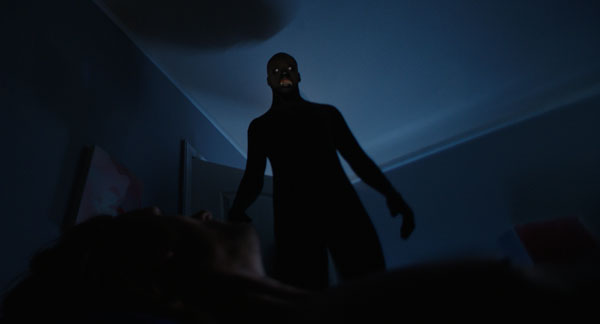
Within sleep paralysis, the common shared appearance of iconic figures such as a “Shadowman” or an alien face, or insect, or snakes and other fear-inducing images that seem to cross all cultures, did not appear specifically for me. I did FEEL a very masculine presence just outside my open bedroom door. As I became aware of my inability to move, I felt the presence grow in strength, hovering outside my bedroom. I did not see a shadow, but I sensed the air in that direction was “heavier,” for lack of a better term, than anything around it. That male presence suddenly advanced into my bedroom, approaching the head of my bed. As it floated toward me, I felt hands grab my ankles and wrists to hold me in place. More hands grabbed various parts of my limbs and began pressing me firmly down into the mattress, holding my chest down. The presence hovered beside my bed. I felt a hand clench over my mouth, making me scream an odd “Mmmph” noise as I tried to call out. Another hand grabbed my forehead, pulling my head backwards over the pillow it was resting on. As I arched upward, facing the wall behind me – the hands suddenly released and I felt the presence no longer.
Scanning the room, I was alone. It was a sudden attack, and thankfully brief.
This was a terrifying experience, which occurred at approximately 5am in the morning. Luckily, a couple of my friends were online and offered me comfort when I described what had happened to me.
In the film “The Nightmare,” it is stressed several times that there is no control over these events, they come and go most often without warning. But, I took comfort in the fact that the subjects of the film seemed to either deal with it in some way or, they happened with less frequency when some life situation shifted.
However, my friend Mike pointed out to me, “You do realize, this could be the just the beginning of something… right?”
Hopefully, not.
Check out “The Nightmare” at their Facebook page or Tumblr.
Watch the trailer